If you have driven the M1 between Brisbane and the Gold Coast during peak hour, you already know the problem. More than 150,000 vehicles use the motorway daily, creating bottlenecks that stretch from Coomera down to Nerang.
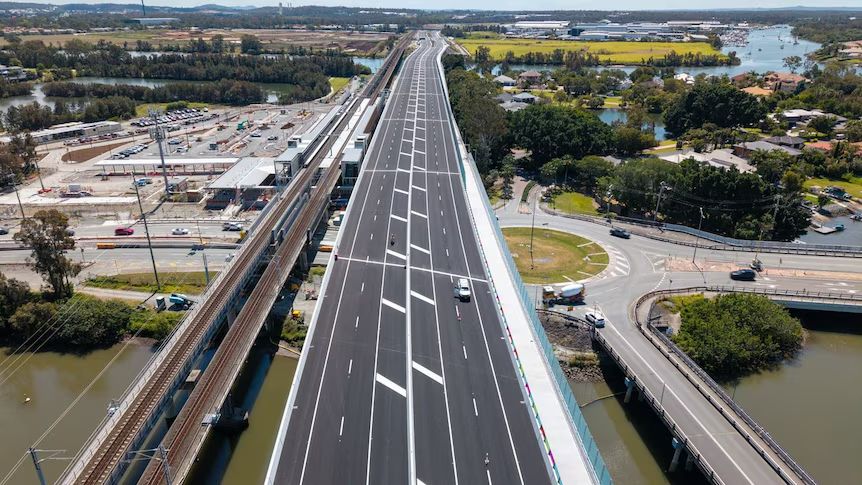
The opening of Stage 1 North on 2 December 2025 marked the first tangible relief for northern corridor commuters. Officially known as the Coomera Connector (M9) Motorway, this $3.5 billion project is not just a road upgrade; it is a $91 billion infrastructure catalyst actively reshaping where people live, work, and invest across South East Queensland.
At COAST Buyer’s Agency, we track how major transport infrastructure flows through to suburb-level property values. In this article, we break down the M9 timeline, analyse the key interchanges, and examine what the latest data from our Gold Coast Property Report 2026 reveals about the suburbs best positioned to benefit.
An overview of the Coomera Connector
Here are the self-contained key facts every Gold Coast property buyer needs to know about the Coomera Connector (M9) Motorway:
- Official designation: Coomera Connector (M9) Motorway, officially confirmed by Transport and Main Roads (TMR) in August 2025.
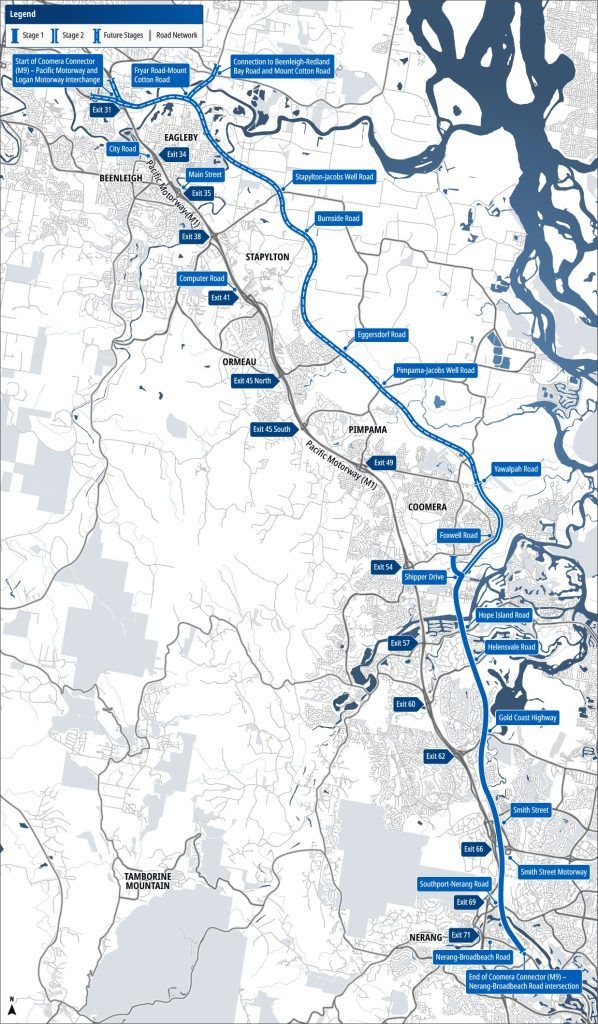
- Full corridor scope: A 45km north-south motorway running from Loganholme to Nerang, positioned east of the M1 and the heavy rail line.
- Stage 1 delivery: A 16km, $3.5 billion joint investment ($1.75B Australian Government, $1.75B Queensland Government) spanning Coomera to Nerang across three construction packages.
- Traffic absorption: Designed to take up to 60,000 local trips per day off the M1, absorbing around 57,000 vehicles daily and reducing Nerang-to-Coomera congestion by roughly 10 per cent.
- Active transport network: Features a continuous 16km shared walking and cycling path connecting local residential hubs, schools, and transit stations.
- Stage 1 North status: The 4km section from Shipper Drive to Helensvale Road officially opened to traffic on 2 December 2025.
Coomera Connector Stage 1 Central and South
While Stage 1 North is already operational, construction is progressing rapidly on the remaining 12km of Stage 1:
- Stage 1 Central (Helensvale Road to Smith Street Motorway): This 8km section represents the core bottle-opener for central commuters. It is being built into six lanes (three each way) to accommodate heavy traffic flows between Helensvale, Parkwood, and the Gold Coast Health and Knowledge Precinct at Southport.
- Stage 1 South (Smith Street Motorway to Nerang-Broadbeach Road): Main works commenced in June 2025 on this 4km, four-lane (two each way) package. It connects southern corridor drivers directly into the central spine near Nerang.
Key interchanges and access Points
Stage 1 includes four major new interchanges and two grade-separated intersections designed to keep local traffic off the M1:
- Helensvale Road Interchange: Directly servicing Helensvale and Hope Island residents.
- Gold Coast Highway Interchange: Connecting to Coombabah and the Northern Beaches.
- Smith Street Motorway Interchange: Providing high-speed access to GCUH, Griffith University, and the Southport CBD.
- Southport-Nerang Road Interchange: Streamlining access into Ashmore, Molendinar, and central commercial hubs.
- Intersections: Shipper Drive (Coomera) at the northern terminus and Nerang-Broadbeach Road at the southern terminus.
Stage 2 and future stages
Look beyond Stage 1, and you’ll find state and federal planners mapping out the full 45km corridor.
- Stage 2 (Pimpama to Coomera): Spanning 5km between Yawalpah Road at Pimpama and Shipper Drive at Coomera, Stage 2 is the next priority section. Expressions of interest opened in mid-2026 for detailed design and site preservation. However, investors should note that Stage 2 remains in planning and design, with no construction funding currently allocated.
- Future Stages (Loganholme to Coomera): The remaining 29km corridor connecting the northern Gold Coast to Loganholme is undergoing long-term corridor preservation and environmental assessments by TMR.
Why it matters for the Gold Coast’s current infrastructure
The Gold Coast is experiencing an unprecedented demographic squeeze. Around 420 new residents migrate to the region every week, pushing the LGA’s population toward one million by 2040.
Without major infrastructure interventions, traffic modelling indicated that a peak-hour trip from Coomera to Southport would blow out from 23 minutes to over an hour by 2041. The M9 is a critical valve in a broader $91 billion infrastructure pipeline, including:
- $2.25B Coomera Public Hospital: Providing essential healthcare services and massive employment growth for the northern corridor.
- $1.25B Light Rail Stage 3: Enhancing connectivity and ease of transit throughout the coastal strip.
- $5.8B Logan and Gold Coast Faster Rail upgrade: Significantly slashing travel times between our major employment hubs.
This pipeline represents a historic level of investment that is not just improving transit, but actively securing long-term capital growth for savvy property buyers in the region.
How motorway infrastructure drives property values
New bypass motorways fundamentally alter property fundamentals in three ways:
- Commute Compression: Suburbs previously considered “too far north” for central Gold Coast or Brisbane workers suddenly enter the 30-minute commute sweet spot.
- Commercial & Infill Release: Bypassing local arterial roads allows local councils to rezone surrounding land for higher-density residential and commercial use.
- Buyer Catchment Expansion: Improved accessibility draws higher-income interstate relocators and healthcare professionals who prioritise travel certainty over beachfront proximity.
The suburbs positioned to benefit
Data from our Gold Coast Property Report 2026 shows that the northern corridor suburbs directly along the M9 alignment are delivering exceptional capital growth and tight rental market fundamentals.
Suburb Breakdown:
- Coomera (4209): It’s the epicentre of northern growth. With median house prices up 21% to $1,021,500 and the new $2.25 billion Coomera Hospital opening in late 2027, Coomera is becoming a major health and transport hub.
- Upper Coomera (4209): This is one of the fastest-selling markets on the Coast. Houses sell in an average of just 21 days, while units ($802,000 median) sell in 26 days, underpinned by top school catchments and M9 proximity.
- Pimpama (4209): Crucially, Pimpama is the single remaining house market on the Gold Coast with a median under $1 million ($950,000). With its new train station open and Stage 2 planning underway, Pimpama offers an accessible entry point with strong near-term catalysts.
- Helensvale (4212): This is the ultimate multi-modal transit hub. Helensvale is the only Gold Coast suburb where heavy rail, light rail, bus interchanges, and now the M9 Motorway converge. The median sits at $1,327,500 with a steady 4.2% yield.
Suburb | Property Type | Median Price (2026) | 12-Month Growth | Gross Yield | Days on Market |
|---|---|---|---|---|---|
Coomera | House | $1,021,500 | +21.0% | 4.0% | 28 days |
Coomera | Unit | $747,000 | +16.0% | 4.3% | 26 days |
Upper Coomera | Unit | $802,000 | +16.0% | 4.2% | 26 days |
Pimpama | House | $950,000 | +12.0% | 4.0% | 25 days |
Pimpama | Unit | $768,000 | +16.0% | 4.4% | 26 days |
Helensvale | House | $1,327,500 | +10.0% | 4.2% | 28 days |
Source: PropTrack data (12 months to March 2026) published in Gold Coast Property Report 2026.
What the data already shows
We don’t have to wait until 2030 to see the property market’s reaction. After Stage 1 North opened in December 2025, buyer activity in northern corridor postcodes spiked significantly.
Transaction Acceleration
You’ll see steady growth in quarterly sales volumes as more buyers target these northern hubs. Intense competition keeps properties moving, often selling within just 21 to 28 days.
Rental Squeeze
You’ll notice vacancy rates in Coomera and Pimpama have plummeted to between 0.8% and 1.1%, well below the 3.0% balanced baseline. This scarcity drives median house rents in Coomera up to $780 per week.
Unit Outperformance
You can see significant house price growth driving up unit values in Pimpama (+16%) and Upper Coomera (+16%), matching or exceeding house price gains. As you look for more affordable options, you directly propel this trend in the unit market.
These metrics show the market is already aggressively pricing in the benefits of the new infrastructure, confirming that northern corridor property is becoming one of the region’s most competitive segments.
Should you buy on the Gold Coast now or wait?
Prospective buyers often ask whether they should buy ahead of major infrastructure completions or wait until the full motorway network opens.
Why buy now?
Property markets price in infrastructure well before the ribbon is cut. Buying before Stage 1 Central and South is complete lets you capture the growth window during construction. Plus, with Gold Coast building approvals down 55% against required demand, supply constraints will keep pushing prices up regardless of broader economic cycles.
Why wait?
Waiting gives you 100% clarity on finished traffic flows and noise barrier impacts. It is a safer bet if you are risk-averse, though sitting on the sidelines almost guarantees you’ll pay a higher entry price later in these key growth corridors.
Navigating specific street-level nuances, like avoiding acoustic impact zones while still securing proximity benefits, is where independent expertise on the ground really pays off.
Get the 2026 Gold Coast Property Report
The Coomera Connector is fundamentally changing the northern Gold Coast, but it is only one piece of the region’s $91 billion transformation. Navigating this fast-evolving market requires suburb-level data, not headline speculation.
At COAST Buyer’s Agency, we help local buyers, interstate relocators, and offshore investors secure premium properties with complete confidence.
Want the complete picture before making your next property move? Download our free, 32-page Gold Coast Property Report 2026 for detailed suburb performance tables, yield rankings, infrastructure maps, and price forecasts co-published with Hotspotting by Ryder.
Download your free copy of the Gold Coast Property Report 2026 »
Ready to turn these insights into an actionable shortlist? Book a complimentary 30-minute discovery call with our team today to discuss how the M9’s expansion can work for your portfolio.