If you are an Australian expat living abroad or a foreign citizen looking to buy property in Australia, you have probably read the recent headlines and wondered if the door is shut. Yes, expats and foreign buyers can absolutely buy property in Australia; they just need to know which regulatory category they fall into and how to navigate the corresponding pathway.
While sensationalist media often scream about “foreign buyer bans,” the rules are highly structured, workable, and designed to facilitate specific investments. In the 2026–27 Budget, the Australian Government extended the temporary ban on foreign purchases of established residential dwellings to 30 June 2029. The practical question is no longer “should I wait?” but: “Which pathway applies to my circumstances, and how do I execute it?”
At COAST Buyer’s Agency, we help local buyers, returning expats, and investors navigate this exact landscape daily. In this guide, we unpack the rules, costs, expat mortgages, and pathways that make buying property in Australia from overseas achievable in 2026.
Rules changed in 2025, and what changed again since
Australia’s foreign investment policy channels international capital into increasing national housing supply. The government welcomes investment that builds new homes and creates construction jobs, but restricts speculation on existing housing stock.
Consequently, a temporary ban on foreign acquisitions of established (existing) dwellings, originally legislated from 1 April 2025 to 31 March 2027, has been extended in the 2026–27 Budget until 30 June 2029.
Under these current laws:
- What is banned: Foreign persons (including temporary residents and foreign-controlled entities) are strictly prohibited from purchasing established dwellings as investment properties or principal residences.
- What is permitted: Foreign buyers are actively encouraged to purchase new dwellings, near-new dwellings, off-the-plan properties, or vacant residential land for development.
Who these rules apply to
Your eligibility under the Foreign Acquisitions and Takeovers Act 1975 depends directly on your citizenship and visa status.
Australian citizens, Permanent residents and New Zealanders
This group enjoys the highest level of flexibility under Australian property law, as they are largely exempt from the foreign investment restrictions that apply to non-residents.
- Australian citizens buying from overseas: You are completely exempt from all foreign investment restrictions. You can buy established homes, new builds, or vacant land anywhere in Australia without government approval or surcharges.
- Permanent residents: PRs are treated the same as citizens under the foreign investment framework, requiring no government approval and exempt from the established dwelling ban.
- New Zealand citizens: NZ citizens holding an SCV do not require investment approval and are exempt from the established dwelling ban.
Temporary residents and non-residents
These classifications determine your specific purchasing constraints and regulatory obligations within the Australian market.
- Temporary residents: Individuals on temporary visas (>12 months) are classified as “foreign persons“. Under the ban, you cannot buy established dwellings, even as a principal residence. However, you can apply to buy new builds, off-the-plan properties, or vacant land.
- Non-residents (no Australian status): You are strictly banned from purchasing established dwellings. Your only open pathways are new constructions, off-the-plan properties, or vacant land for development.
While the landscape of established housing is restricted, the door to Australian property ownership remains wide open through new-build and off-the-plan pathways. For temporary and non-residents, these are active, government-endorsed routes to securing a high-quality asset in one of the world’s most stable property markets.
To see how these rules stack up side-by-side, review the comparison table below:
Australian property buying eligibility by status (2026)
Buyer Residency Status | Buy Established Dwellings? | Buy New? | FIRB Approval Required? | QLD 8% AFAD Surcharge? |
|---|---|---|---|---|
Australian Citizen (Expat) | Yes (Unrestricted) | Yes (Unrestricted) | No | No |
Permanent Resident (PR) | Yes (Unrestricted) | Yes (Unrestricted) | No | No |
New Zealand Citizen (SCV) | Yes (Unrestricted) | Yes (Unrestricted) | No | No |
Temporary Resident (Visa) | No (Banned)* | Yes (Conditional) | Yes | Yes |
Non-Resident (Offshore) | No (Banned)* | Yes (Conditional) | Yes | Yes |
*Limited exceptions apply, such as established dwellings purchased for redevelopment that significantly increase housing stock (building at least 20 additional homes).
The tips and tricks that actually help
Navigating the buying process from offshore is highly achievable once you apply several proven strategies:
1. New builds and off-the-plan pathways
New builds and off-the-plan properties are the simplest route. Many developers hold a pre-approved exemption certificate, meaning you won’t need individual FIRB approval.
2. Buying jointly with an eligible spouse
If you are married or in a de facto relationship with an Australian citizen or permanent resident, you may buy property jointly as joint tenants without FIRB approval.
3. Timing your purchase around a return
NZ citizens and temporary residents physically in Australia may secure favourable stamp duty treatments once they satisfy the “ordinarily resident” test. Plan your transaction around your relocation.
4. FIRB and finance in parallel
Since FIRB approvals can take 30 days, run your mortgage pre-approval and FIRB application simultaneously to move quickly.
5. Budgeting for QLD AFAD
Queensland levies an 8% Additional Foreign Acquirer Duty (AFAD) on foreign buyers. Factor this surcharge into your deposit calculations early.
6. Using a buyer’s agent
Engaging an on-the-ground buyer’s agent, like COAST Buyer’s Agency, secures an expert proxy. We handle inspections, unedited video walkthroughs, and negotiations on your behalf.
Expat home loans in 2026
Securing an expat mortgage in Australia is highly viable, though Australian banks assess foreign income conservatively.
When applying from offshore, expect:
- Currency haircuts: To shield against currency swings, banks shade your foreign salary (applying a 10% to 30% haircut) during serviceability assessments.
- LVR limits: Most expat and non-resident lending is capped at an 80% Loan-to-Value Ratio (LVR), requiring a 20% deposit plus transaction costs.
- Rigorous documentation: You must supply certified copies of foreign tax returns, contracts, bank statements, and credit files.
Working with a specialised expat mortgage broker who understands which lenders currently favour specific foreign currencies is essential to securing a competitive interest rate.
About FIRB fees, AFAD, and the surcharges
To illustrate typical costs, let’s look at a worked example for a non-resident purchasing a new unit at the Gold Coast average unit median of $978,718:
Worked example of foreign buyer costs on a $978,718 Gold Coast unit
Cost Item | Rate | Estimated Cost (AUD) |
|---|---|---|
Purchase Price | Base Asset Value | $978,718 |
FIRB Application Fee | Sliding scale | Standard Fee* |
Standard QLD Transfer Duty | Standard QLD rate | Standard Duty |
QLD AFAD Surcharge | 8.0% of purchase price | $78,297.44 |
Annual Vacancy Fee | If left vacant > 183 days/yr | Equal to FIRB Fee |
*Note: FIRB application fees are adjusted annually by the ATO and must be paid at the time of submission. Expats (Australian citizens) and permanent residents pay $0 in FIRB fees and are completely exempt from the 8% AFAD surcharge.
Why the Gold Coast is the number one expat-return market
For returning Australians and foreign professionals, the Gold Coast is a premier destination. In the two years to January 2024, the region absorbed 40,874 international migrants, driven by several key structural factors.
1. A maturing economy
The Gold Coast has transitioned from a holiday town into Australia’s fastest-growing economy. Gross Regional Product is $49.4 billion, with construction ($5.04B) and health care ($4.5B) overtaking tourism as the largest sectors.
2. The 2032 Olympic Games
Up to six venues will host events, with the Games injecting $2 billion into the Gold Coast economy and driving major infrastructure upgrades.
3. Elite education & lifestyle
Proximity to top-tier schools and major institutions like Griffith (21,000 students) and Bond (4,500 students) underpins local demand.
4. Global price advantage
Expats from Singapore, Hong Kong, or London find excellent relative value. While Gold Coast unit medians ($978,718) now lead all capital cities, they are far more affordable per square metre than equivalent premium offshore markets.
Top Gold Coast suburbs for expats
According to our Gold Coast Property Report 2026, returning expats and international buyers concentrate in four key suburbs:
- Surfers Paradise (4217): The undisputed liquidity capital, with 1,345 unit sales (12 months to March 2026), a $830,000 unit median, and high appeal for international arrivals.
- Southport (4215): The Coast’s civic and medical core. Southport offers premium units ($750,000 median) yielding a high 4.8% gross yield near the hospital precinct.
- Clear Island Waters (4226): A premier residential enclave featuring secure luxury homes and deep canal frontage.
- Arundel (4214): Situated near the Health and Knowledge Precinct, offering family homes ($1,260,000 median) and superb highway links.
These areas offer a diverse mix of lifestyle and investment profiles, catering to both the high-density demand of international arrivals and the long-term capital growth sought by returning residents.
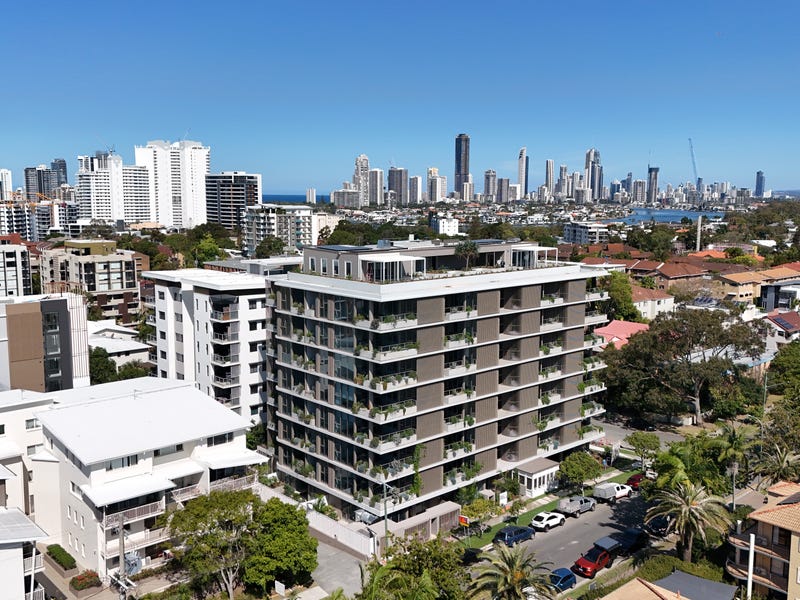
Southport, QLD – Apartments and Units
The buying process end-to-end for an overseas buyer
Buying property in Australia from overseas follows a structured, eight-step sequence:
- Eligibility check: Clarify if your residency status requires FIRB approval or incurs the 8% QLD AFAD surcharge.
- Finance pre-approval: Secure formal borrowing pre-approvals via a specialist expat mortgage broker.
- FIRB submission: Lodge your application on Online Services for Foreign Investors and pay the processing fee.
- Inspection by proxy: Use a buyer’s agent on the ground to inspect properties and perform structural due diligence.
- Offer or auction: Your buyer’s agent negotiates terms or bids on your behalf.
- Exchange contracts: Secure the property with contracts conditional on final FIRB approval.
- Digital settlement: Your legal representative settles the transaction via PEXA from offshore.
- Ownership registration: Log your asset on the Register of Foreign Ownership within 30 days. Ensure occupancy or genuine rental for 183 days annually to avoid vacancy fees.
By following this structured sequence, you mitigate risk and ensure compliance with regulatory obligations, allowing you to focus on securing your ideal property rather than navigating administrative hurdles.
Get in touch with COAST Buyer's Agency
Buying property from overseas is straightforward once you understand the rules. With the established housing ban extended to June 2029, the framework is locked in, offering medium-term regulatory certainty.
At COAST Buyer’s Agency, we act as your trusted local advocate. Our relationships, valuations, and due diligence help you secure premium off-market properties with confidence. Before taking your next step, download our free Gold Coast Property Report 2026 for comprehensive suburb data and infrastructure maps.
When you are ready to transition to an actionable strategy, we are here to help.
Provide your details below, and we’ll be in touch to arrange a FREE 30-minute no-obligation discovery call to help you with your buying strategy.