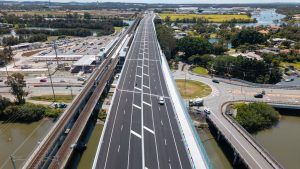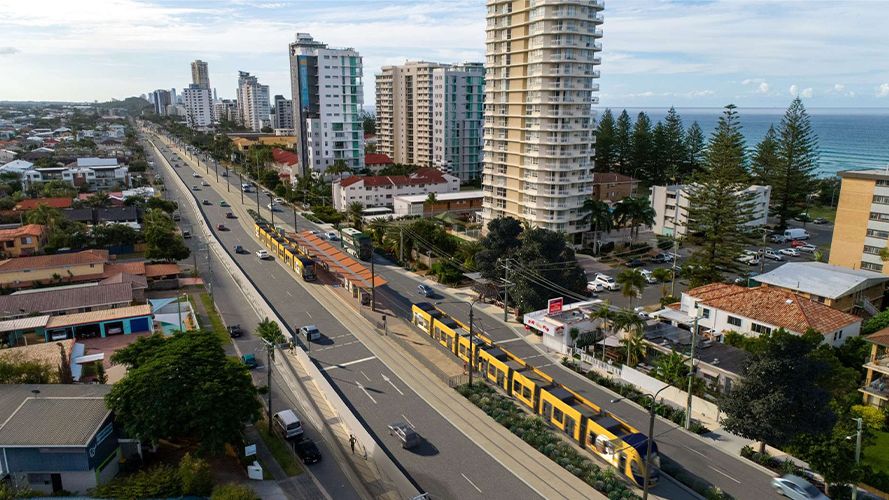
Stage 3 of the Gold Coast light rail adds eight new stations between Broadbeach South and Burleigh Heads.
This article breaks down the impact of the light rail development on properties bordering this corridor, built on suburb-level data from the Gold Coast Property Report 2026, our joint publication with Ryder Property Research. Figures are current to March 2026.
About Stage 3
Stage 3 is a $1.2 billion, 6.7km extension of the G:link network running south from Broadbeach South to Burleigh Heads, adding eight new stations and five additional trams. The Australian Government, the Queensland Government, and the City of Gold Coast jointly fund it, delivered as a public-private partnership with the GoldlinQ consortium.
The track runs as a dual-line down the centre of the Gold Coast Highway, with two traffic lanes retained on either side. GoldlinQ puts the end-to-end journey from Broadbeach South to Burleigh Heads at 16 to 17 minutes.
Once open, the network runs 27km from Helensvale to Burleigh Heads, with 27 stations and 23 trams. New bus interchanges land at Miami and Burleigh Heads, with east-west connections at Christine Avenue and Goodwin Terrace.
Early works began in 2021, and major construction began in 2022. A tram made the first full run from Broadbeach South to Burleigh Heads on 30 April 2026. Transport and Main Roads expects passenger services to begin in mid-2026.
The 8 new stations
North to south, the eight new stations are:
- Mermaid Beach, near the Gold Coast Highway at Crescent Avenue and Montana Road
- Mermaid Beach South, just south of Markeri Street
- Nobby Beach, at the Chairlift Avenue dining strip
- Miami North, opposite Miami State High
- Miami, between Hythe Street and Miami Shore Parade
- Christine Avenue, carrying east-west bus connections
- Second Avenue, on the northern edge of Burleigh Heads
- Burleigh Heads, just south of Goodwin Terrace
Broadbeach South is not a new station. It is the existing Stage 1 terminus, and it becomes the junction.
Group those by suburb, and the picture sharpens. Mermaid Beach takes three, counting Nobby Beach, which sits inside the Mermaid Beach boundary. Miami takes three. Burleigh Heads takes two, one of them the southern terminus.
That concentration is the point. Miami and Mermaid Beach each collect three stations across a short stretch of highway.
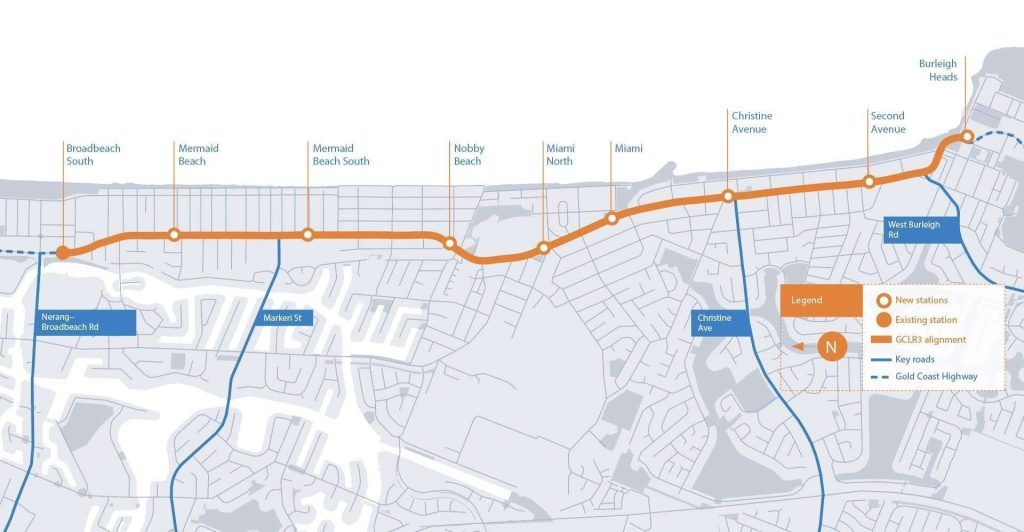
Gold Coast Light Rail Stage 3 Map – sourced from www.gclr3.com.au
What light rail actually does to property values
Markets with multiple demand drivers carry greater depth, more buyer competition and better resilience during a downturn. Proximity to local infrastructure is one of the things that make the Gold Coast a strong investment, alongside a 1.3% vacancy rate and 8.6% house rental growth in the twelve months to February 2026.
The mechanism is not mysterious. A station changes how many people can reach a street without a car, which widens the buyer and renter pool. It also shapes what the Council can justify approving nearby, since the twenty-year growth vision concentrates higher-density housing along transport spines rather than scattering it.
What a station does not deliver, though, is a uniform lift. This corridor already contains the strongest performing house market in the report and one of the flattest. A station 400 metres away is a different proposition from one across the highway from your balcony.
Mermaid Beach: three stations
Mermaid Beach recorded the strongest house market movement in the report, with its median up 32% to $3,350,000 across 75 sales. It also carries the lowest house yield on the Gold Coast at 2.3%.
Those two facts together tell you what a Mermaid Beach house is: a lifestyle asset, priced accordingly, where the tram is a convenience rather than an investment thesis.
The unit market is a different conversation. At $976,279 across 247 sales, it returns 4.4%, close to double the house yield, and it sits at roughly 29% of the house median. Unit rents are $830 a week with vacancy at 1.2%.
House rents rose 17% to $1,400 a week over the year, though house vacancy at 2.5% is among the lower readings in the report’s rental sample.
Mermaid Beach recorded population growth above the LGA rate between 2023 and 2024. In the Mermaid Beach and Broadbeach area, 11.4% of residents had moved up from NSW or Victoria in the five years to 2021.
Miami: three stations
Miami is where the corridor data gets interesting.
The house median sits at $1,900,000 across 76 sales, up 1% over the year and 3.3% over the five-year average. House rents rose 17% to $1,200 a week, with vacancy at 1.2%. The report records only 2.1 months of supply in the Miami house market, among the tightest readings it publishes.
The unit market is $1,150,000 across 159 sales, up 6% over the year and averaging 15% over five years, returning 4.0%, with rents at $850 and vacancy at 1.4%.
Miami takes three of the eight stations: Miami North, opposite the high school; Miami, in the heart of the suburb; and Christine Avenue, which becomes a bus interchange.
Miami also recorded population growth above the LGA rate and carries the strongest transaction signal in the corridor.
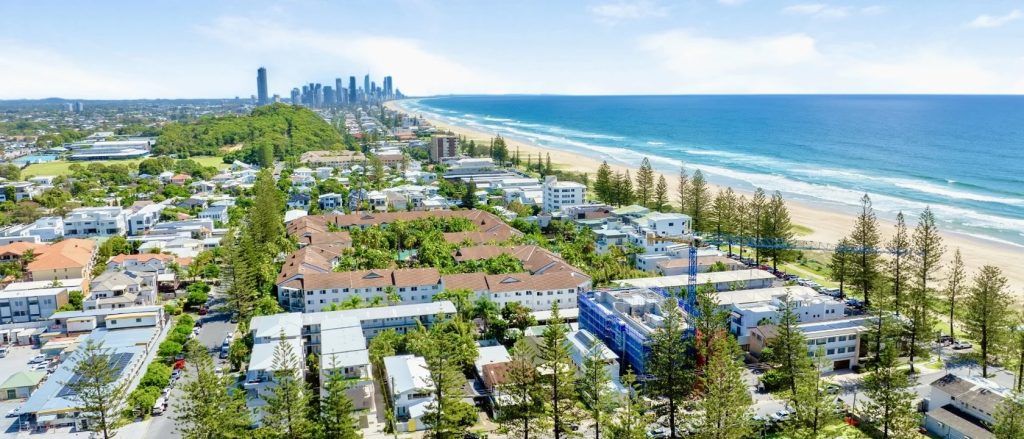
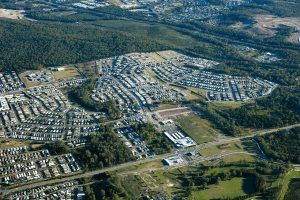
Aerial view of Miami, Gold Coast
Burleigh Heads: two stations
Burleigh Heads is the southern terminus, which matters more than the station count suggests. Terminus stations concentrate interchange traffic, and this one carries east-west bus connections into it.
The house median is $1,850,000 across 125 sales, up 3% over the year and averaging 15% per year over five years, yielding 3.3%. House vacancy is 0.8%, among the tightest in the report’s sample, though house rents held flat at $1,200 over the twelve months.
Units sit at $1,180,000 across 226 sales, up 1%, returning 3.8%, with rents at $863 and vacancy at 2.0%.
Burleigh Heads recorded 2.4% population growth, and 8.3% of residents had moved from NSW or Victoria in the five years to 2021.
Of the three corridor suburbs, Burleigh Heads posted the slowest twelve-month movement in both houses and units.
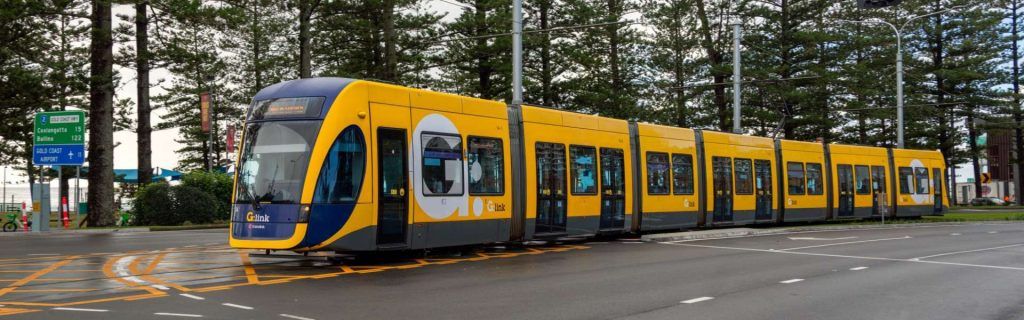
G:link Stage 3 testing in Burleigh Heads 2026
The unit opportunity along the corridor
One pattern repeats in all three suburbs: units yield more than houses.
Mermaid Beach units return 4.4% against 2.3% for houses. Miami units return 4.0% against 3.3%. Burleigh Heads units return 3.8%, up from 3.3%.
Entry prices tell the same story. A Mermaid Beach unit at $976,279 is roughly 29% of the house median there. In Miami, it is about 61%, in Burleigh Heads, about 64%.
That is consistent with the region. Units outsold houses across the Gold Coast in the twelve months to March 2026, 8,265 to 8,153. Of the 43 unit markets the report analyses, 32 carry medians below $1 million. All 20 markets returning yields of 4.5% or higher are unit markets. Median unit prices rose 14.39% over the year, against 11.71% for houses.
Light rail suits unit stock in a way that it does not suit detached housing. The stations sit on the highway, and the density is already there.
The rising transaction signal
Our report tracks suburbs where quarterly sales volumes have risen steadily since December 2024, on the basis that volumes move first and prices react.
Of the three corridor suburbs, one appears: Miami units, up 89% in quarterly sales between December 2024 and December 2025. That is the strongest unit reading in the table, and across the entire list, only Tallai houses sit higher.
What happened to Stage 4?
Stage 4 is not proceeding. On 1 September 2025, the Crisafulli government announced it would not go ahead, following a review. Deputy Premier Jarrod Bleijie said two-thirds of southern Gold Coast residents had objected, and that the review indicated a cost of up to $9.85 billion against an original commitment of under $3 billion.
Stage 4 would have run 13km from Burleigh Heads to Coolangatta via the Gold Coast Airport, with nine stops.
This matters for anyone who bought south of Burleigh on the expectation of a tram. Palm Beach, Tugun, and Currumbin are not getting one, and any pricing that anticipated it was based on something that will not arrive.
In June 2026, the government announced what would come instead. The GC Surfer is a metro-style articulated bus service, modelled on Brisbane Metro, running roughly every ten minutes between Robina, Varsity Lakes, Burleigh Heads, Gold Coast Airport and Coolangatta. Separately, on 22 June 2026, a new light rail spur was announced, branching from Gold Coast University Hospital station along Olsen Avenue to Musgrave Avenue, Labrador and Harbour Town at Biggera Waters, across three new stations. Both are slated for delivery before the 2032 Games.
The investor takeaway
Three suburbs, three different propositions.
Miami carries the strongest case on the report’s own numbers: three stations, 2.1 months of house supply, and the corridor’s only rising transaction signal at 89% for units.
Mermaid Beach splits hard. Houses are a lifestyle asset at a 2.3% yield. Units at 4.4% are the investment conversation.
Burleigh Heads takes the interchange and the tightest house vacancy at 0.8%, alongside the slowest twelve-month price movement of the three.
Across all three, units out-yield houses and cost less to enter.
This is general information about market conditions and is not personal financial advice. Your own position depends on circumstances we cannot see from here.
The suburb data behind this piece comes from the Gold Coast Property Report 2026, covering every Gold Coast house market with 30 or more sales and every unit market with 30 or more sales in the twelve months to March 2026. Download the report for medians, yields, five-year growth and days on market across all 97 markets.