For most of the past decade, the standard advice on a Gold Coast investment property pointed one way: buy a house, hold the land, and watch it grow.
In 2026, the data tells a more interesting story. For the first time on record, more units sold than houses across the Gold Coast, and on several measures that matter to investors, units are now setting the pace. This piece lays out the case with the numbers to back it up, because the shift is real and many investors have yet to catch up.
In this article, we run through some core figures from our recent Gold Coast Property Report 2026.
The headline data
In the twelve months to March 2026, the Gold Coast recorded 8,265 unit sales against 8,153 house sales. Units overtaking houses on transaction volume is a genuine first for a market built on the quarter-acre block and the canal-front home, and it reflects where buyer demand is actually flowing.
The Gold Coast unit market median now sits at $978,718, which is higher than the unit median in any Australian capital city, Sydney included. For a city once filed under affordable coastal alternative, leading the nation on apartment values is a remarkable position to hold. Independent data has tracked the same crossover, with the Gold Coast unit median moving ahead of Sydney’s through late 2025 and holding the lead since.
Taken together, the volume and price signals point in the same direction. The question of units versus houses Gold Coast investors once treated as settled is open again, and the evidence for units is stronger than it has been in years.
The price growth story
Over the past year, unit prices grew by 14.39%, while house prices grew by 11.71%.
Both results are strong, and units are clearly ahead. Look deeper, and the pattern holds across the city rather than resting on one or two prestige pockets. Of the 43 suburbs that recorded at least 30 unit sales, 23 saw unit sales grow faster than house sales. That is more than half the established unit markets on the coast moving the same way at once.
Over five years, average unit growth ranged from 8% to 19% depending on the suburb, while house growth ranged more widely from 5% to 29%. Houses still hold the top of that range, and that is the point worth understanding. The best house markets can still outperform, and units now offer a more consistent floor of growth across a far wider set of suburbs.
For an investor spreading risk across the Gold Coast property market, that consistency carries real value because it broadens the range of suburbs where a sound result is likely, rather than concentrating the upside in a handful of premium streets.
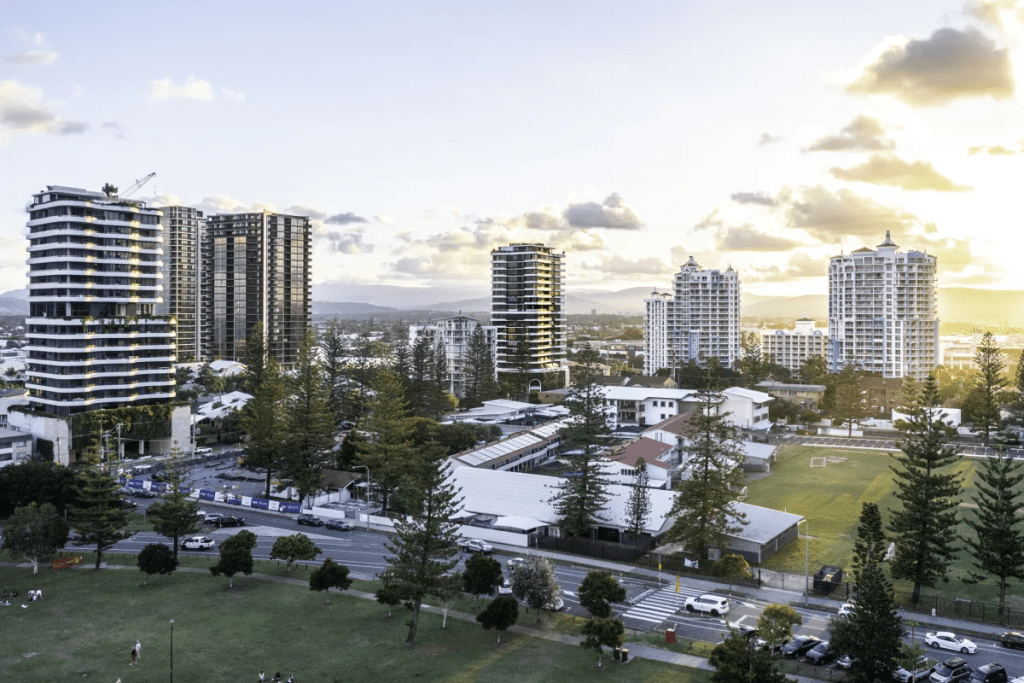
LAANI Mermaid Beach – luxury apartments development
The yield story
Surfers Paradise recorded 1,345 unit sales over the year at a median of $830,000 and a gross yield of 4.6%. Several suburbs sit higher again: Ashmore at 5.2%, Merrimac and Molendinar at 5.1% each, and Southport at 4.8%. Houses across comparable suburbs typically return closer to 4%, so the yield gap is meaningful and compounds over a holding period.
This is a natural place to address a question many investors ask: what is the 1% rule?
The 1% rule is an American screening shortcut that states that monthly rent should be at least 1% of the purchase price. Almost no property in a major Australian market clears that bar, and the Gold Coast is no exception. Its value here is comparative rather than absolute. On the 1% test, a unit yielding above 5% sits far closer to the mark than a house yielding around 4%, which reinforces the same conclusion the yield figures already point to. Units are simply working harder for their owners on the income side.
Why this is happening
Several forces are pushing in the same direction. The clearest is affordability. With the median house price well above $1.1 million, a large share of buyers and tenants now sit priced out of detached homes and are moving towards well-located apartments instead. That migration of demand supports both unit prices and unit rents, and it shows little sign of easing while houses remain this expensive.
Supply is the second force. New apartment completions are forecast to fall from around 1,900 in 2025 to roughly 1,400 in 2026, with very few expected in 2027. High construction costs and limited coastal land keep new projects slow and expensive to deliver. Fewer new units arriving against rising demand is a textbook recipe for price and rent growth, and it is the single most important dynamic in the Gold Coast unit market right now.
Population is the third. The Gold Coast continues to draw strong interstate migration, and rental vacancy sits below 1%, well under the 3% that signals a balanced market. Downsizers and interstate buyers are also reshaping the product itself, lifting demand for larger, owner-occupier-style apartments that hold their value better than older one-bedroom investor stock. The result is a market where quality apartments are competing for genuine lifestyle demand, not just investor interest.
Where the unit opportunity is strongest
The common follow-up is which Queensland suburbs will perform in 2026. The honest answer is that the Gold Coast is a collection of micro-markets rather than a single market, so the opportunity lies in specific pockets rather than in the city as a whole.
For yield with growth, the inland suburbs stand out:
- Ashmore
- Merrimac
- Molendinar
- Southport
For investors who want the rent to cover the holding costs, this is the sweet spot, and it tends to attract less competition than the coastal strip does.
For growth with lifestyle demand, the light rail corridor rewards attention. Gold Coast Light Rail Stage 3, extending the network to Burleigh Heads, is expected to open in mid-2026, and apartments within walking distance of the new stations tend to attract a completion premium as the construction disruption clears.
Surfers Paradise units and Broadbeach apartments for sale sit firmly in this category, anchored by walkability, amenity, and consistent tenant demand. Broadbeach in particular has matured into the city’s cosmopolitan centre, supported by the convention centre and major retail, which gives its apartment market a depth of demand that holds up across cycles.
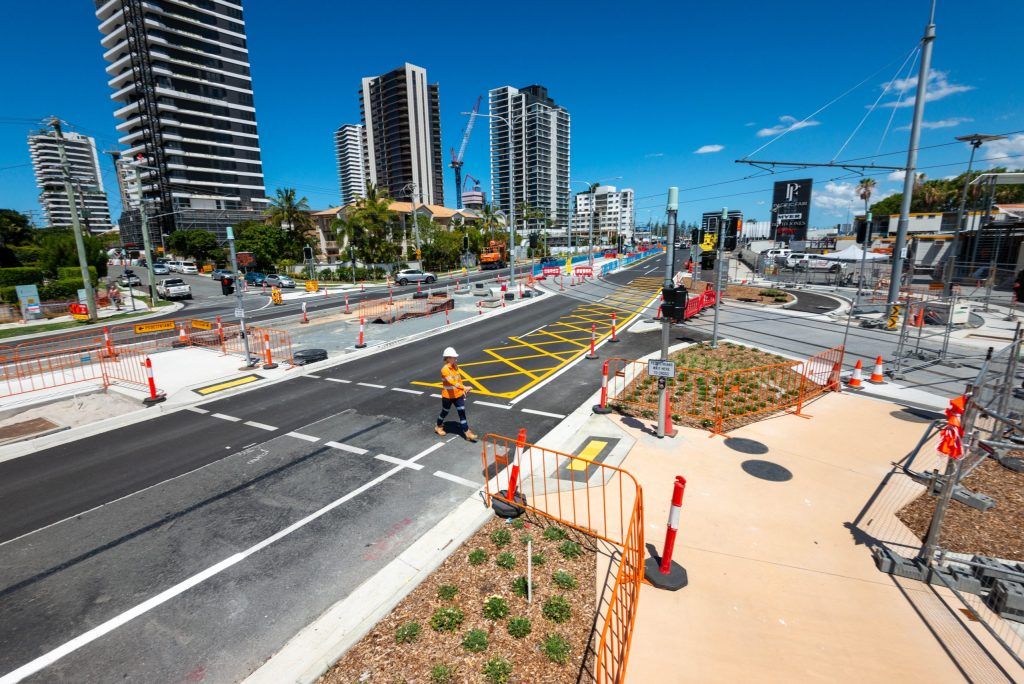
Gold Coast Light Rail Stage 3 – Construction nearing completion in 2026
The unit markets to be cautious about
A balanced thesis names the risks, and not every unit is a strong buy. A few segments warrant care.
The first is oversupplied luxury stock, particularly whole-floor and very large format apartments in buildings where many near-identical units compete for the same small pool of buyers. Scarcity drives value, and that segment often lacks it.
The second is an older one- and two-bedroom investor stock in high-density towers with steep body corporate fees. A strong headline yield can shrink quickly once those costs come out, so the net return deserves close scrutiny before the figure on the listing wins you over.
The third sits at the southern end. Light Rail Stage 4, which would have extended the line from Burleigh Heads to Coolangatta and the airport, was cancelled in September 2025. Any unit bought on the expectation of that specific catalyst now needs a fresh assessment on its own merits.
The contrarian case against units (and why it falls short)
The traditional argument runs that houses always win because you own the land, and land appreciates while buildings depreciate. It is a sound principle, and it shaped a generation of buyer’s agents who default to houses. The 2026 data invites a closer look.
The land argument assumes you can access land at a price that still leaves room to grow. On the Gold Coast, the entry point for a house now sits beyond the reach of many investors, which caps the buyer pool and, with it, future demand. Units sit where demand actually is, among the priced-out, the downsizers, and the interstate arrivals who want beach access without a $1.5 million commitment.
The depreciation argument also softens under scrutiny. Well-located apartments in supply-constrained corridors have outgrown plenty of house markets across the past five years, and the demand and supply forces behind that look set to continue.
Land still matters. The claim that it always wins is the part the current data challenges, and a thesis that ignores the evidence in front of it serves no investor well.
What this means for your 2026 strategy
So, is the Gold Coast a good place to invest in property? On the current evidence, yes, and the unit market is the part of the story most investors have yet to price in. The combination of record demand, constrained supply, stronger yields, and broad-based growth gives Gold Coast apartment investment a genuinely compelling profile heading through 2026.
The practical takeaway is to match the asset to your goal. For income that supports the holding, the higher-yielding inland suburbs lead the way. For growth, the supply-constrained coastal and light rail corridors lead. For most investors, a well-located unit now offers a better balance of the two than it has at any point in recent memory, which is exactly why the units-over-houses thesis deserves a place in your 2026 planning.
Price and yield data set the direction. Suburb-level detail decides the outcome. The 2026 Gold Coast Property Report breaks down unit performance suburb by suburb, so you can see exactly where the numbers support a buy.
If you would like to apply this directly to your budget and goals, our buyer’s agents track this market every day. Book a free consultation call, and we will help you map the unit opportunity to your strategy.