If you’ve been waiting for the right time to move into a bigger home or a better location, a softer market can actually work in your favour. If your family has outgrown your home, the usual path is to sell and buy again. But more upgraders we work with are asking a different question: can we keep our home, rent it out, and use its equity to buy the next one?
For the right family, it can be a smart way to move. You don’t have to sell into a softer market; you keep a property you already know, and you can buy your next home while there’s more choice and less competition. It isn’t right for everyone, though. It means more debt, two properties to manage and some tax questions that need an accountant’s answer.
In this guide, we explain how keeping your home and upgrading works, what the 2026 negative gearing changes mean for families considering it, what to check before you commit, and the Gold Coast suburbs where we see families moving.
Reasons to keep your existing home as an investment property
1. You don’t have to sell into a softer market
Gold Coast values fell 0.7% over the quarter to September 2026, with houses down around 1% and units broadly stable. That’s a modest adjustment, but the uncertainty and low confidence are delivering fewer buyers at each open home and vendors more willing to negotiate on price.
That’s good news and presents an opportunity when you’re buying. It’s less helpful when you’re selling. Keeping your current home means you don’t have to rely on a sale in these conditions to fund your next purchase, and you avoid selling costs like agent commission and marketing.
2. You can buy while there’s more choice
We’re seeing more homes come to market, fewer buyers competing for each one, and vendors who are more realistic about price. For families, that means time to inspect properly, compare options and negotiate terms, rather than deciding on the spot to beat a crowd.
3. Your current home may keep its negative gearing treatment
The 2026–27 Federal Budget announced that, from 1 July 2027, negative gearing will be restricted for established residential properties bought after 7.30 pm AEST on 12 May 2026. Losses on those properties will only be able to offset other residential property income, not your salary. Properties already held at that time are grandfathered, and new builds are exempt.
That matters for upgraders, as draft legislation released by Treasury in August 2026 would generally keep a family home bought before the Budget-night cut-off grandfathered if rented out later. An established investment property bought today would not.
So for some families, the home they already own may be the investment they’d find hardest to replace. Whether that makes keeping it the better choice depends on your income, your loans, and how the property performs as a rental, which your accountant can help you assess.
4. You hold two properties through the market cycle
Keeping your home means you own two properties instead of one. If values rise over the years you hold them, you benefit across both. The reverse also applies: you carry more debt, and both properties are exposed if values fall. The Australian property market typically moves through 7- to 10-year cycles, with different states, cities and regions operating within their own ‘submarket’ of booms, stabilisations, downturns and upturns. Property value slumps are only temporary, while property values in Australia’s major regions seem to rise permanently over the long term.
How keeping your home and upgrading works
Step 1: Your current home becomes a rental
Before you commit, get a rental appraisal from a local property manager to understand what the home is likely to rent for and what it may cost to get it rent-ready. Factor in landlord insurance, property management fees, rates, maintenance and periods without a tenant. Queensland has its own rental rules, so check your obligations as a landlord with the Residential Tenancies Authority.
Step 2: You use the equity for your next deposit
Equity is the difference between what your home is worth and what you owe on it. Most lenders let you borrow against part of it, typically up to 80% of the home’s value, minus your current loan. That “usable equity” can fund the deposit and buying costs on your next home.
Here’s a simple illustration. The figures are hypothetical and rounded. They show how the calculation works, not what a lender will offer you.
|
Example |
Amount |
|---|---|
|
Current home value |
$1.2 million |
|
80% of value |
$960,000 |
|
Less your current loan |
$400,000 |
|
Usable equity (before lender assessment) |
$560,000 |
How much you can actually borrow depends on your income, expenses and how the lender treats the rent from your current home. That’s why it pays to talk to a broker before you start looking.
Step 3: You buy your next home with a clear brief
With finance in place, you can buy as a buyer only, without waiting on a sale. That puts you in a stronger position to negotiate on price, settlement timing and conditions in a market with fewer competing buyers.
What to check before you keep your home and upgrade
Keeping your home can work well, but it changes your finances in ways that are easy to underestimate. Before you commit, work through these with your broker and accountant:
- Borrowing capacity across two loans: lenders assess both repayments and usually count only part of the rent. Confirm what you can borrow before you make an offer.
- How the loans are structured: whether interest is tax-deductible generally depends on what the borrowed money is used for, not which property secures it. Borrowing against your rental to buy your new home doesn’t usually make that interest deductible. Get the structure right before settlement, as it’s hard to fix later.
- Capital gains tax on your current home: your home is generally exempt from CGT while you live in it. Once you rent it out, special rules apply, including the option to keep treating it as your main residence for up to six years in some cases. You generally can’t have two main residences at once. Your accountant can explain how this applies to you.
- Whether the grandfathering applies to you: it depends on when you bought your home and on the final legislation. Confirm both before relying on it.
- Cash flow and buffers: rental income rarely covers every cost. Plan for vacancies, repairs and rate changes across two loans.
- Whether your home suits renting: not every family home makes a strong rental. Location, tenant demand and upkeep all matter.
If keeping your home doesn’t suit: buying and selling a house at the same time
The hardest part of upgrading is usually timing. There’s no single right answer as it depends on your finances, how quickly your home is likely to sell, and how much risk you’re comfortable with. As an experienced buyer’s agency, we’ve helped clients in the following scenarios through our vendor advocacy service.
1. Buy first, then sell
You secure the home you want before you list your own. This suits families who have found the right property, or are targeting a suburb where good homes rarely come up.
The upside is that you don’t miss the right home, and you only move once.
This scenario isn’t particularly ideal for all, as you carry two properties for a time and face pressure to accept a lower offer on your current home if it takes longer to sell.
2. Sell first, then buy
You sell your current home, then buy with a known budget. This suits families who want certainty about their numbers.
The upside is a clear budget, and you can negotiate as a buyer with no sale to wait on.
What you need to watch out for, though, is the possibility of renting in between, or feeling rushed to buy before your settlement date.
3. Line up both settlements
Many upgraders aim to settle both properties on the same day, known as a simultaneous settlement. The proceeds from your sale go straight towards your purchase, so you move once and avoid carrying two loans. This requires both contracts, your lender, and both conveyancers lined up, and a delay on one side can affect the other.
If the dates don’t line up neatly, there are other levers:
- A longer settlement on the home you sell, or a delayed settlement on the home you buy
- A rent-back arrangement, where you stay in your sold home as a tenant for a set period after settlement
- A contract subject to the sale of your home, which gives you a set time to sell before the purchase becomes unconditional
In a softer market, vendors are often more open to negotiating timing and conditions like these. Engaging a buyer’s agent for vendor advocacy can help you negotiate conditions that suit your situation while coordinating settlements on your behalf.
Gold Coast suburbs families are upgrading into
Every family’s brief is different, but a few suburbs keep coming up again and again with the upgraders we work with: beachside locations with established streets, good schools within reach, and room to grow.
Burleigh Heads
Burleigh Heads strongly appeals to families. The headland and Burleigh Head National Park sit at one end of the beach, and Tallebudgera Creek offers calm water for younger swimmers. The village around James Street and the Esplanade gives the suburb a walkable, local feel, and major retailers and commercial hubs are just a 5-minute drive away.
Gold Coast’s light rail construction wrapped up in August 2026, now ending at Burleigh Heads and connecting the city from the North in Helensvale through Miami, Broadbeach, Surfers Paradise, Southport and the Gold Coast University Hospital, with a new bus and light rail interchange at Burleigh Heads.
House values have averaged 15% growth a year over the past five years, and rose 3% in the 12 months to March 2026.
Robina
Robina suits families who want space and convenience in a more suburban setting. It was planned around lakes, parkland, and a central town centre, with many homes on quiet residential streets close to everyday services.
For schooling, Robina State School (Prep to Year 6) and Robina State High School (Years 7 to 12) both operate under catchment-based enrolment. Local private schools Somerset College in Mudgeeraba and All Saints Anglican School in Merrimac are a short drive away. And Bond University is a landmark in Robina itself.
Robina Town Centre is one of the coast’s major retail and dining hubs, with Robina Hospital close by. Pacific Fair is also a short 10-minute drive from Robina residents, giving families access to many retail, transport, and recreation facilities.
Additionally, the local Cbus Super Stadium hosts Titans home games, and the neighbouring Robina station marks the end of the Gold Coast train line, making the commute to Brisbane or the airport straightforward.
In Robina, house values rose 11% in the 12 months to March 2026, with average annual growth of 15% over five years.
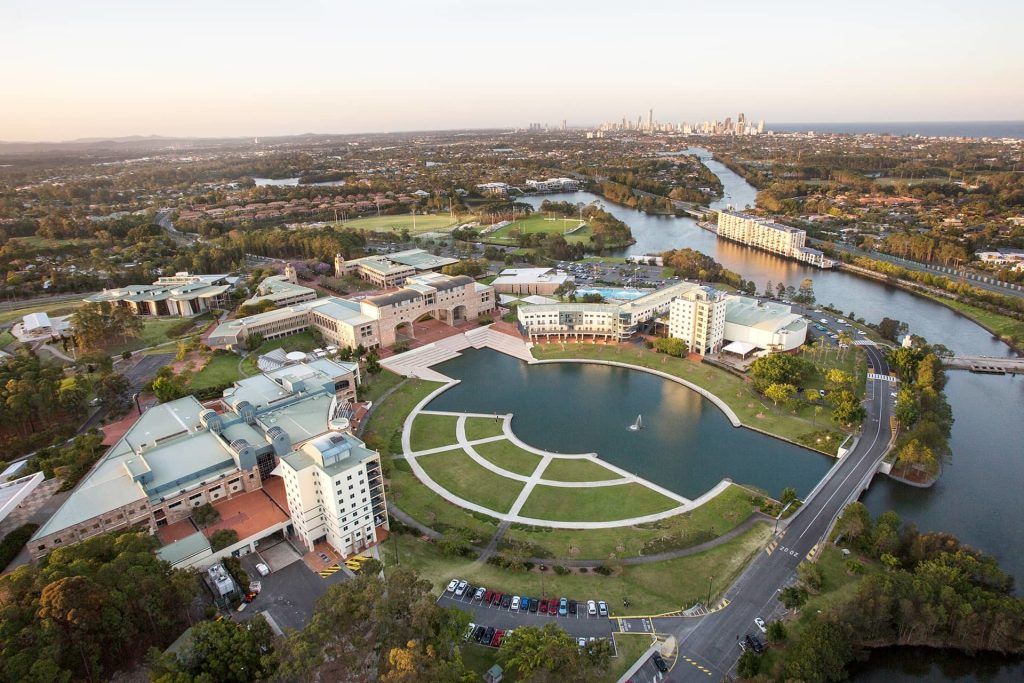
Bond University and aerial of Robina, QLD
Helensvale
Helensvale is a practical choice for families who commute or travel often. It has a settled, established feel, with many streets backing onto parks, canals, and lakes.
For schooling, Helensvale State School covers the primary years and Helensvale State High School the secondary years, with both enrolling by catchment.
Westfield Helensvale is the suburb’s main retail hub, with supermarkets, dining, and a cinema. Helensvale station is where the Gold Coast train line meets the light rail, so families can reach Brisbane by train or head south through Southport to the beaches without getting in the car.
On weekends, Movie World and Wet’n’Wild are only minutes away at Oxenford, and the Coombabah Lake wetlands are close by for walks and birdwatching.
In Helensvale, house values rose 10% in the 12 months to March 2026, with average annual growth of 13% over five years.
Pacific Pines
Pacific Pines is a master-planned community on the northern Gold Coast, designed with families in mind. It has generous parkland, walking and cycling trails, lakes, and playgrounds, and Central Park, with its lake, picnic areas, and barbecues, is the local weekend gathering spot.
For schooling, Pacific Pines State School and Pacific Pines State High School are both within the suburb, so many families can walk or ride to school from Prep through to Year 12.
Pacific Pines Town Centre covers everyday needs, with a supermarket, medical and dental services, and cafés. Westfield Helensvale is a 10-minute drive away, and local buses connect to Helensvale station for the train and light rail. The theme parks at Oxenford are also a short drive away.
Pacific Pines is one of the coast’s faster-moving house markets, with homes selling in a median of 25 days. House values rose 14% in the 12 months to March 2026, with average annual growth of 15% over five years, so it pays to have your finance and inspections lined up early.
Broadbeach Waters
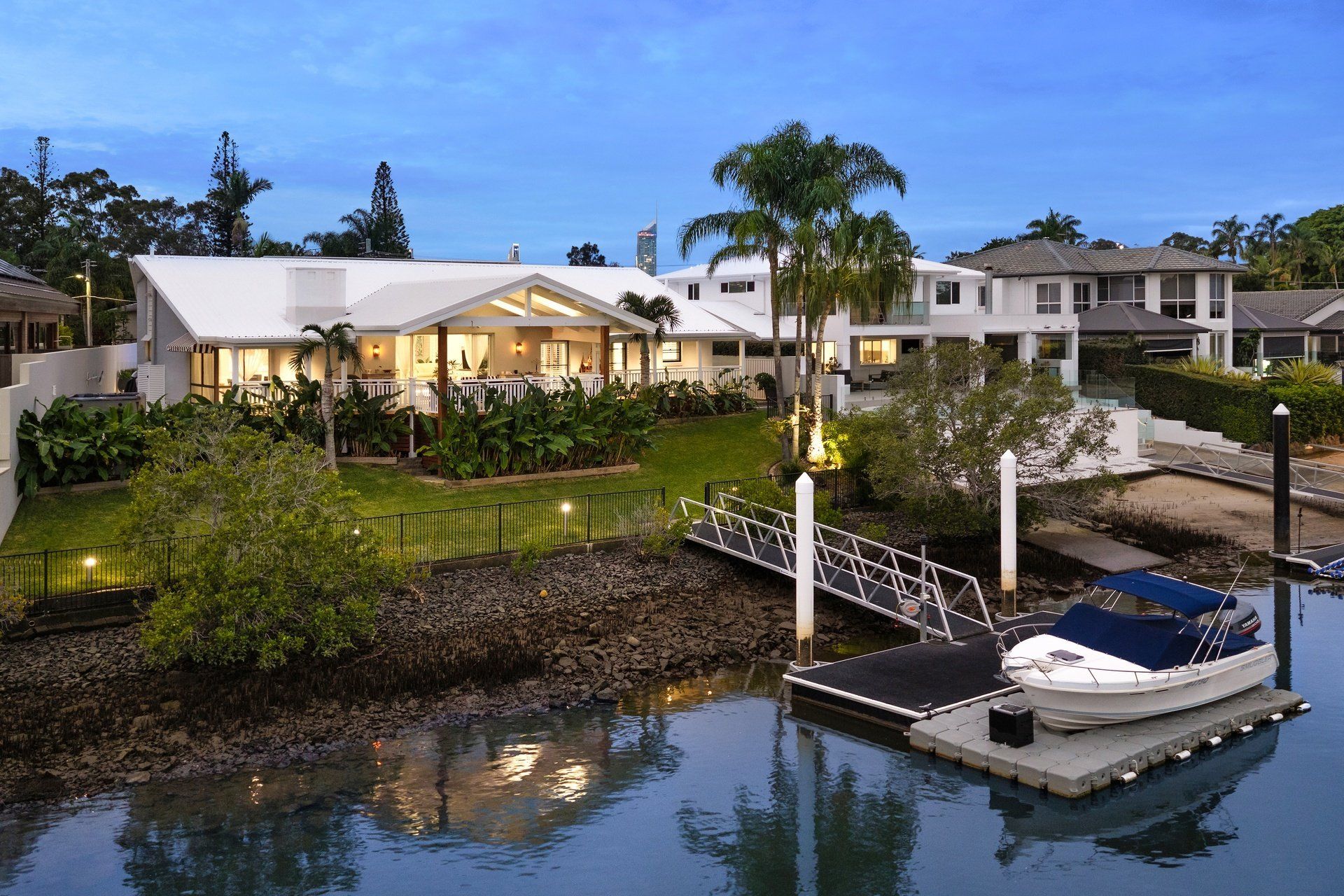
Broadbeach Waters offers canal-front living just minutes from Broadbeach and neighbouring beaches. Many homes have their own pontoon or water frontage, with room for a pool, a boat, and a growing family.
For schooling, many Broadbeach Waters addresses fall within the Broadbeach State School and Merrimac State High School catchments.
Pacific Fair, one of Queensland’s largest shopping centres, sits right on the suburb’s doorstep, with Broadbeach’s restaurants and cafés a short drive or bike ride away. HOTA, Home of the Arts, is also nearby for galleries, outdoor cinema, and weekend markets, while the canals and Nerang River are popular for paddling and boating.
Additionally, the light rail stations in Broadbeach connect families north to Surfers Paradise and Southport, and now south to Burleigh Heads.
In Broadbeach Waters, house values rose 15% in the 12 months to March 2026, one of the coast’s strongest results, with average annual growth of 14% over five years.
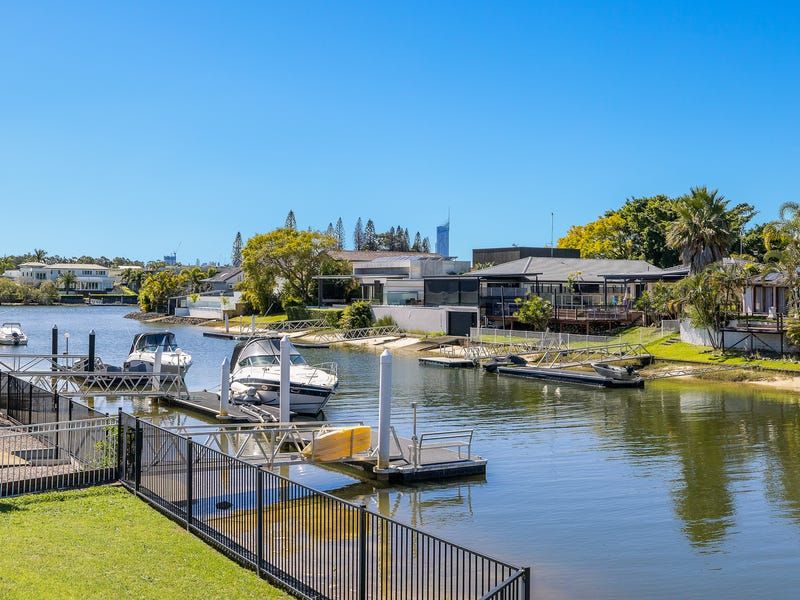
1 Cedar Place, Broadbeach Waters, QLD 4218 – realestate.com.au
What to check before you upgrade
Most families upgrade for something specific, such as an extra bedroom, a bigger backyard, a better school catchment or a beachside location. When we work with families at the beginning of a brief, we start with the reason you’re moving, then test each property against it. Consider:
- School catchments: check the Queensland Department of Education catchment maps for the exact address, not just the suburb
- Commute and transport: travel times at peak hour, and access to the M1 and light rail
- Land and layout: whether the home suits your family in five or 10 years, not just today
- Building and pest inspections: worth doing on every home, even when competition is lower
- Flood and overlays: check the City of Gold Coast flood maps and planning overlays for the address
- Body corporate: if you’re considering a townhouse or apartment, review the records and levies
A softer market can make a cheaper home tempting. But we believe in buying better rather than cheaper. A well-located home on the right street, with the features your family needs, is the one most likely to suit you for years to come.
How a buyer’s agent helps families upgrade
Whether you keep your current home or sell it, upgrading means a major purchase while juggling work and family. As a buyer’s agent on the Gold Coast, COAST Buyer’s Agency represents only buyers and manages the purchase process from start to finish. We help with:
- Finding the right home: we search the market and our agent network, including off-market and pre-market opportunities that may never reach the portals
- Pricing it properly: we assess each property against recent comparable sales, so you know what it’s worth before you make an offer
- Negotiating price and terms: including settlement timing and conditions, which matter most when you’re also selling. See our private treaty negotiation service
- Working with your advisers: we work alongside your broker, accountant and conveyancer so your finance, structure and settlement line up
Learn more about our full-service buyer’s advocacy.
Get in touch with COAST Buyer’s Agency
Ready to find a home that grows with your family? Navigating a softer market doesn’t have to be overwhelming when you have a local expert on your side to help you secure the right property on your terms.
Book a free family strategy session with Joe today to chat through your options and map out your next move with confidence.